Blog
Baking Substitution Rules: What Swaps and What Breaks
Substitution charts say « use X instead of Y ». The honest version adds a factor, a context and a warning — because a swap that saves a muffin can sink a custard. These are the rules behind the ratios.
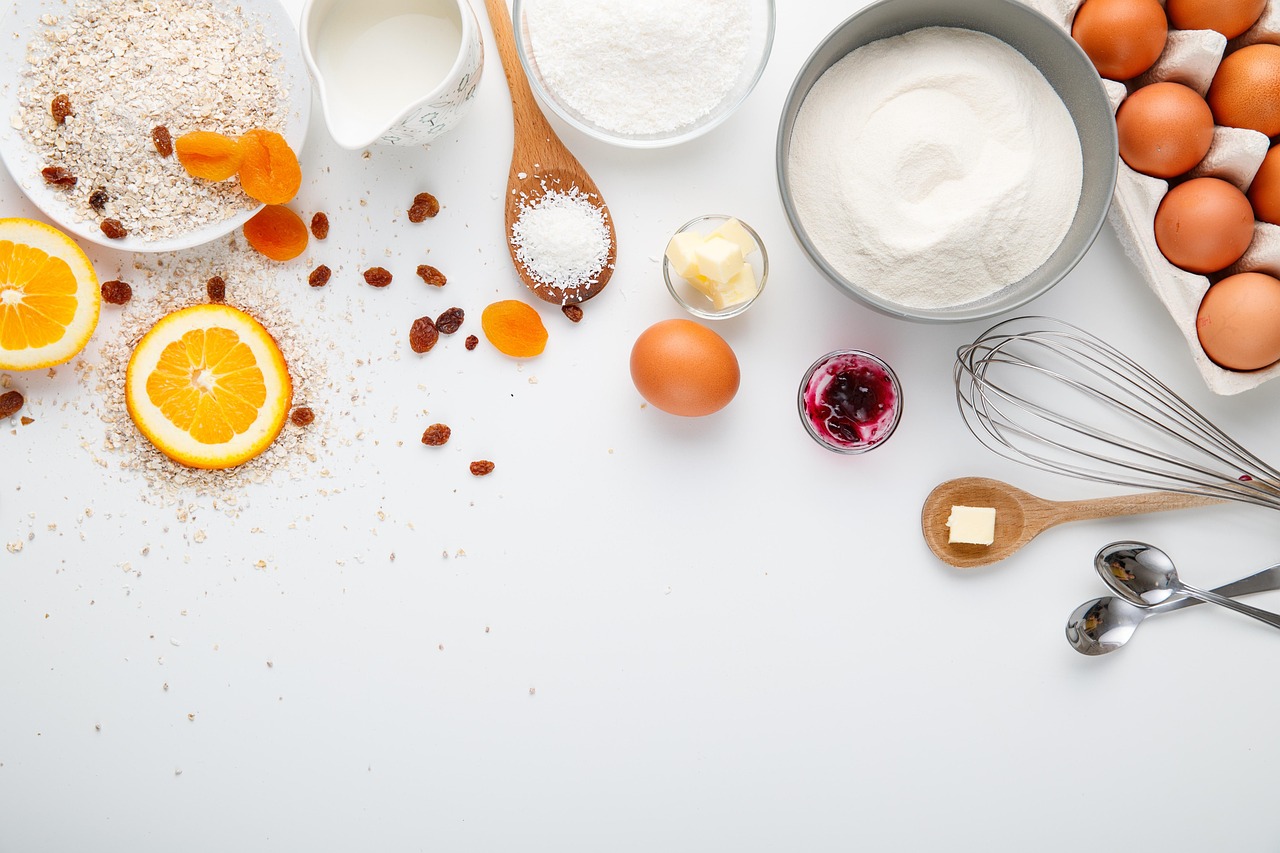
Substitute the role, not the ingredient
Every ingredient in a batter has a job: structure, fat, sweetness, moisture, lift. A substitution works when the replacement does the same job at a similar rate — and fails when it does a different job, or the same one at a different strength. That is why every swap in our data carries a factor, an « applies to » field and a caveat, not just a name.
Fats swap with fats — check the fat percentage
Butter is only about 80 % fat, so replacing it with neutral oil takes three quarters of the weight: 0.75 times the butter mass. Margarine goes 1:1 and gives the closest texture — but a low-fat spread is margarine in name only and ruins pastry. Ghee trades at 1:1 as well, richer and browning less because the milk solids are gone.
- Butter → neutral oil: 0.75× — butter is ~80 % fat, oil ~100 %
- Butter → margarine: 1:1 — check the fat %, low-fat spreads break pastry
- Butter → ghee: 1:1 — richer, less browning
- Butter → coconut oil: 0.8× in baking only
Liquid sugars for liquid sugars, milks for milks
Honey and maple syrup exchange 1:1 — same sweetness, maple just thinner and with its own note. Swapping honey for granulated sugar is a different sport: 1.25 times the sugar weight, plus about a quarter cup of liquid per cup of honey removed to rebalance moisture. Among milks, whole milk moves to oat milk 1:1 with decent body; almond milk also swaps 1:1 but runs thinner — fine in cakes, weaker in custards where milk proteins do the setting.
The swaps that break
Three families resist exchange. Eggs are architecture in flans, custards and soufflés — a flax egg binds a muffin beautifully and will never coagulate a custard or whip into a meringue. Baking soda is about four times stronger than baking powder and only works in an acidic batter — swapping powder for soda without lemon, yogurt or honey leaves the lift unrealized and a soapy taste behind. And gluten-free flours swapped 1:1 for wheat flour give no structure at all unless a binder — xanthan, psyllium, eggs — does the job gluten was doing.
The caveat rule: every ratio carries its conditions
A substitution without context is a rumor. Each entry in the substitution data ships with three guards: a factor (how much), an « applies to » field (baking, cooking or both) and a caveat (what changes). The reliability flag tells whether the swap was tested in a kitchen or cross-checked against references — treat a tested swap as a recipe, and a reference one as a well-informed hypothesis to try on a forgiving cake first.
One question before any swap
Ask what the ingredient does in this specific recipe. Butter in a sauce is flavor — swap freely. Butter laminated into a croissant is structure — nothing in your cupboard replaces it. The swaps that work do so because the role is preserved; when the ingredient is the recipe — eggs in a flan, gluten in bread — the honest answer is to cook something else.